How to Find Trending Content for Your Marketing Newsletter
A practical method for finding trending content for marketing newsletters: where to look, how to read the signals, and how to turn one week of chatter into one issue.
It's Thursday night. Your newsletter ships tomorrow, and you have nothing worth sending. Here's a one-hour weekly routine for finding something that is.
Last spring a friend who runs a marketing newsletter told me about a note on her phone. It's called "emergency issue." It holds a list of evergreen links she pastes in when she has nothing. She uses it more than she'd like to admit. Her readers have never noticed. She notices every time.
A newsletter is a promise on a schedule. The schedule doesn't care if the internet gave you anything good this week. So you scroll. Reddit in one tab. X in another. A YouTube search, three Slack groups, a folder of saved blogs. Two hours later you have forty tabs open and one half-formed idea.
130.3 million
Reddit reported 130.3 million daily active uniques in Q3 2026, up 12% from a year earlier. That's a lot of people telling each other, in public, what they care about.
Source: Reddit, Inc. Q3 2026 earnings release (SEC Form 8-K)
There's plenty to read. The hard part is reading it fast. Below is the method I'd use to fill a newsletter every week with no budget and no team. It comes down to one habit: watch for strangers who keep saying the same thing.
Look for the same story in three places
Everyone says "find what's trending." But a pile of posts isn't always a trend. It might be one outrage cycle, one bot network, or one celebrity having a bad Tuesday.
A real signal passes three tests:
- It shows up on more than one platform.
- It comes from people who don't know each other.
- It's still growing a few days later.
Here's what that looks like. Say you write for people who run small online shops. On Monday, someone on Reddit asks why their checkout sales dropped. On Wednesday, a few people on X complain about the same drop, in almost the same words. By Friday, a YouTuber has posted a video on possible causes. Three platforms, three sets of strangers, one question. Your readers are already wondering about it.
One platform is a post. Two is a story. Three is a trend.
What a real signal looks like over seven days
Illustrative shape, not measured data. In this example, Reddit threads, X posts and YouTube videos increase together across seven days and keep growing.
What each platform tells you
Each one gives you something different. You need all three.
Reddit shows you what people are confused about. Threads are long, specific and honest. The questions in a niche subreddit are close to a free reader survey. Sort by Rising, not Top. Top is last week's news.
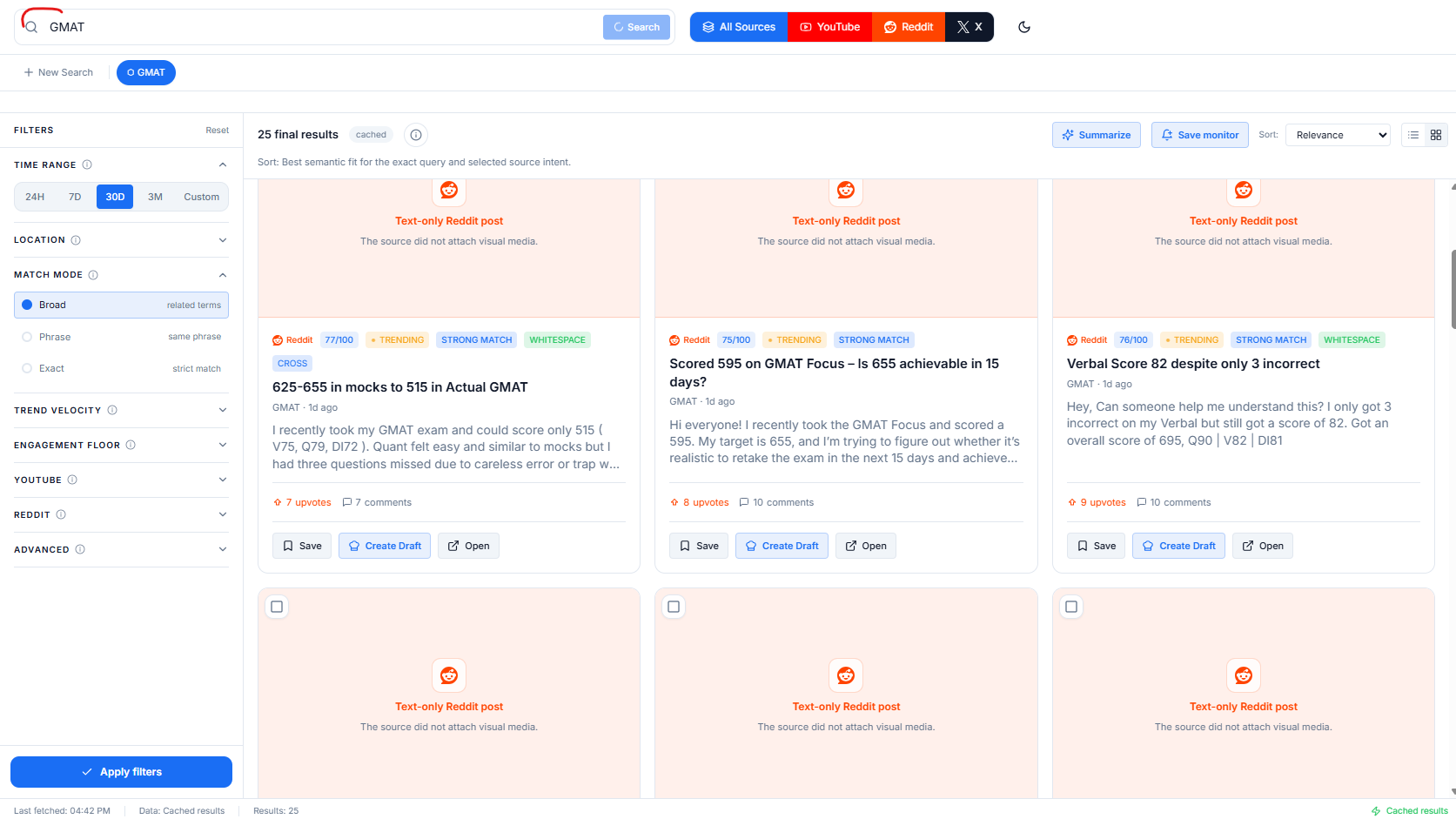
Example: in our GMAT test below, one Reddit post did most of the work: 695 on a practice test, 515 on the real exam two days later.
X shows you how people are saying it. It's fast and noisy. Look for the phrase that keeps getting repeated, or the take that keeps getting quoted. That phrase is often your subject line.
Example: if five strangers call a price change a "stealth tax," you have your headline.
YouTube shows you what people will sit through. A video that's still collecting comments weeks later is a topic with staying power. Read the comments. That's where the objections are.
Example: if the top comment on a how-to video says "this didn't work for me," you've found your angle.
The one-hour weekly routine
Cap the time. An open-ended scroll will eat your whole afternoon. Run these five steps in order.
- Pick three to five watch topics. Not your whole industry. Just the subjects your readers actually reply about. A SaaS newsletter might pick pricing, AI features and churn.
- Collect, don't read. Spend 15 minutes saving links and copying phrases from Reddit, X and YouTube. No opinions yet. If you judge while you collect, you'll chase the loudest thing.
- Cluster by repetition. Group what you saved by the question it answers. Anything with only one platform behind it goes in a "maybe" pile.
- Score each cluster. Is it growing, flat or fading? Are the people talking unrelated? Does it tie to a decision your reader has to make this month?
- Pick one lead and two supports. The lead gets your real writing. The other two get a paragraph and a link.
Watch out
A spike that dies in a day is usually outrage or a coordinated push. If nobody's still talking about it 48 hours later, hold it. You can cover it next week with better information.
We tried it on the GMAT
Theory is cheap. So we ran the routine on a noisy topic: the GMAT, the business-school entrance exam. Picture a newsletter for MBA applicants that needs an issue for the first week of November. We watched Reddit, X and GMAT Club from October 5 to November 4, 2026, and followed the five steps.
27 threads
Our Reddit pass covered 27 threads across r/GMAT, r/MBA and r/GRE: 556 upvotes and 437 comments in 30 days. Add X and GMAT Club, and one complaint turned up on all three.
Source: our own pull, October 5 to November 4, 2026. The engine read each thread's text and top comments, not every reply. Upvote counts are as of November 4.
The story that kept coming back
Great practice score. Bad exam day. Four people who have never met told the same story in nineteen days.
One complaint, three sources, nineteen days
| Date | Source | Post |
|---|---|---|
| Oct 15 | 695 official mock, 515 real exam two days later | |
| Oct 18 | GMAT Club | Verbal 93rd percentile in practice, 18th on test day |
| Nov 3 | 625 to 655 in mocks, 515 real | |
| Nov 3 | X (a prep tutor's account) | 725 practice, 645 test |
Now run the three tests:
- More than one platform? Yes. Reddit, GMAT Club and X.
- Unrelated voices? Yes. A tutor who sells prep, plus students who don't.
- Still alive days later? Yes. The posts run from October 15 to November 3.
Read the comments, not just the post
Replies on the 695-to-515 thread offered a likely cause. Students retake the free official mocks, see repeat questions, and inflate their own scores. One commenter said they saw "5 Quant and 2 DI questions again." That comment gave the issue its angle.
What the maybe pile gave us
Clusters that didn't make the lead still gave us supporting paragraphs:
- Data Insights, especially Multi-Source Reasoning. One student "wasted 10 minutes trying to brute-force the MSR" and lost every question in that set. Their score fell from a 685 to 705 practice average to 595. It climbed back to 655 once they planned to skip that set.
- The Superscore. It launched on August 12, 2026. GMAC sends it with every score report, with no opt-out. Applicants keep asking if schools care. Secondary reporting says Booth, Kellogg and Tuck don't accept it and Darden does. We haven't checked each school's own page, so a newsletter would need to.
- Is the GMAT still worth taking? One post on X said 44% of Harvard's Class of 2027 sent a GRE score and 34% sent a GMAT score. That's a secondhand figure from one account. Verify it before you print it.
- Doubt about prep sellers. One commenter said the sub's regulars "are mostly tutors" who benefit from pushing retakes. Quote posts like this. They help a newsletter earn trust.
The issue, in three lines
- Lead: why your practice score is lying to you, and how retaking free mocks inflates it.
- Support: a pacing plan for Data Insights. Skip a bad Multi-Source Reasoning set instead of brute-forcing it.
- Support: what the new Superscore does and doesn't change, with each school's current policy checked first.
Subject line: Your practice score is lying to you.
Monday action for the reader
Before you book the exam, take one practice test you've never seen, under real timing. If you've already used the free mocks, treat those scores as a ceiling.
What this pull couldn't tell us
YouTube wasn't part of this run. X gave us very few real student posts; most were prep-company promos and spam. Reddit gave us dates and votes only on a second pass. We saw one claim about test centres handing out answers and left it out because it's unverified. A real newsletter would fill the YouTube gap before publishing.
The part that eats the hour
Steps two and three take the most time. The chatter is spread across platforms that were never built to be read together. So you collect by hand: search, scroll, screenshot, paste, repeat. It works. It's also why that "emergency issue" note exists.
We built trendingcontent.net to fix this. Give it your keywords. It pulls the conversation from Reddit, X and YouTube into one list, so you read one feed instead of three tabs. You still write the newsletter. It cuts the prep, which is the part most people give up on.
From signal to issue: three questions
Spotting the trend gets you halfway. The rest is telling readers what to do about it. For each lead story, answer three questions in plain words. Here's how they play out for the GMAT issue.
What's happening? Two or three sentences and one link to a primary source. Skip the scene-setting.
GMAT: Test takers keep reporting real scores far below their practice scores.
Why are people talking about it? Quote the words people actually used. Readers trust a newsletter that sounds like the room it describes.
GMAT: Retaking free mocks means seeing "5 Quant and 2 DI questions again."
What should my reader do on Monday? One concrete action. If you can't name one, the topic is interesting, but it isn't an issue.
GMAT: Take a practice test you've never seen, under real timing, before you book.
Keep a swipe file
Save every cluster you scored, even the ones you skipped. Some patterns only show up across weeks. Your "maybe" pile from March is often your lead in May.
Four ways a curated issue goes stale
- Leading with the biggest story instead of the most useful one. Everyone will cover the big product launch. Your readers may get more from a small thread about the bug it caused.
- Linking to the same ten sites as everyone else. If your readers saw it in three other newsletters, it's filler.
- Summarizing a thread without picking a side. Tell readers which comment you'd trust. In the GMAT thread, we'd point to the one about repeat questions.
- Chasing every spike. You end up with a lot of links and no point of view.
The fix is the same for all four: have an opinion. A curator who says "this matters, that doesn't" is worth subscribing to. A curator who lists everything is just a feed.
Try it this week
You don't need a new system. Tonight, pick three watch topics. This week, spend one hour collecting, clustering and scoring. Write one lead and two supports. Then check two things: was the issue easier to write, and did more readers reply?
Skip the forty tabs
Trending Content is free to start. Track the conversations your readers are already having. Send an issue you're proud of.
Join trendingcontent.netSources & notes
Reddit Q3 2026 figures: Reddit, Inc. earnings press release, Form 8-K. The seven-day example is an illustration of a typical shape, not measured data. The online-shop, "stealth tax" and how-to-video examples are hypothetical illustrations. GMAT figures come from our own pull of Reddit, X and GMAT Club, October 5 to November 4, 2026.